Table of Contents
ToggleBuilding a home theater means more than mounting a big screen and calling it a day. The seating makes or breaks the experience, literally, if you cheap out on quality. Unlike tossing a couch in front of the TV, dedicated theater seating delivers ergonomic support for two-plus hour movie marathons, integrated features like cupholders and USB ports, and viewing angles optimized for screen height. Whether converting a basement or claiming a spare bedroom, the right furniture transforms a dark room into an actual cinema experience. This guide walks through what separates theater seating from living room leftovers and how to choose pieces that fit both the space and the viewer.
Key Takeaways
- Home theater seating furniture is engineered for extended viewing comfort with recline geometry (130-160 degrees), optimized row spacing, and integrated features like cupholders that standard living room furniture cannot match.
- Power recliners ($600-$1,500+ per seat) offer silent, independent control of backrest and legrest via remote, while manual recliners ($300-$700) are budget-friendly but create noise and require body movement that can disturb neighbors.
- High-density foam cushions (1.8-2.5 lbs/ft³) with hardwood or steel frames are essential for long-term durability; low-density foam and particleboard frames degrade within 3-5 years under repeated recline stress.
- Screen viewing distance should follow SMPTE guidelines: the closest seat at 1.5× screen width away and the farthest at 2.5× width to avoid pixel tracking or detail loss.
- Electrical infrastructure, including dedicated 15-amp circuits and surface raceways for retrofit installations, must be planned before purchase to avoid costly modifications.
- Upholstery choice depends on lifestyle: bonded leather suits light use, top-grain leather ages well but requires maintenance, and performance fabric is best for homes with kids or pets.
What Makes Home Theater Seating Different from Regular Furniture
Standard furniture prioritizes flexible use, conversation seating, eating pizza during the game, napping. Theater seating zeroes in on one job: screen viewing for extended periods without neck strain or fidgeting.
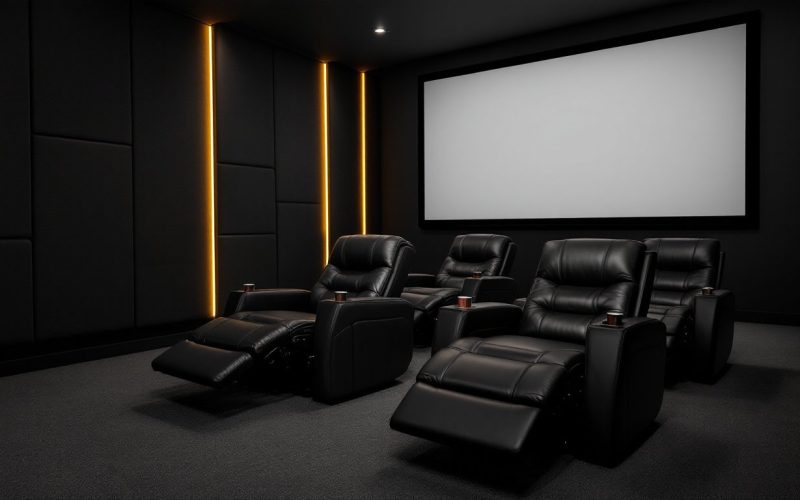
Recline geometry is engineered differently. A living room recliner typically sits upright at 100-105 degrees with a footrest that pops up. Theater recliners deploy to 130-160 degrees with an extended chaise-style leg rest, keeping the viewer’s eye line aligned with a wall-mounted screen positioned 24-36 inches above floor level. That angle matters when the screen is the only focal point.
Row spacing and cupholders are standard, not afterthoughts. Most theater chairs include molded cupholders on armrests and a seat pitch (front-to-back spacing) of 36-42 inches, tighter than living room furniture but enough to avoid kicking the seat in front. Armrests are often fixed-width to prevent sagging and maintain aisle access in multi-row setups.
Upholstery choices lean toward bonded leather, synthetic leather, or performance fabrics that resist spills and don’t absorb sound. Plush chenille or linen might look great in a designer profile, but they’ll absorb popcorn butter and reflect sound waves poorly. Theater-specific materials support acoustic treatment rather than fighting it.
Weight and anchoring differ, too. Many theater recliners weigh 80-120 pounds per seat and include floor anchor points to prevent rocking or tipping during recline. Regular recliners rarely offer this, which becomes a problem on carpeted platforms or tiered flooring common in dedicated theater builds.
Types of Home Theater Seating Furniture
Recliners and Power Recliners
Manual recliners use a lever or pull-tab mechanism to deploy the footrest and adjust the backrest. They’re the budget option, $300-$700 per seat for entry-level models, and require no electrical hookup. The trade-off: occupants need to use body weight to shift positions, which can jostle neighbors in a shared row and creates noise during quiet scenes.
Power recliners run on electric motors, typically dual-motor systems that control the backrest and legrest independently. A wired or battery-powered remote (or a control panel on the armrest) lets users adjust silently and incrementally. Expect to pay $600-$1,500+ per seat. These require 120V outlets, so plan electrical drops during the room build or run surface-mounted cable raceways if retrofitting. Some models add USB charging ports, LED cupholders, and even massage or heating functions, helpful for long Blu-ray marathons, unnecessary for casual viewing.
Seat width for theater recliners runs 20-24 inches. Standard living room recliners are 28-32 inches, which eats up precious floor space in a 12×16-foot room. Narrower seats allow three-across configurations where a couch might only fit two comfortably.
Sectionals and Modular Seating
Curved or straight sectionals built for home theaters come with integrated consoles, storage compartments, and fixed or motorized recline. These work well in smaller spaces (10×12 feet or less) where a single row is the only option. A three-seat theater sectional with a center console typically spans 90-110 inches wide and 40-45 inches deep when fully reclined.
Modular seating uses individual chairs that lock together via metal or plastic connector plates on the base. This setup offers flexibility: start with two seats, add a third later, or rearrange into separate rows as the space evolves. The modular approach appeals to DIYers who prefer phased upgrades over a full-room commitment.
Loveseat configurations pair two recliners with a shared armrest or center console. They’re a middle ground between singles and sectionals, easier to move through doorways (many don’t fit down basement stairs as one piece) and simpler to reupholster if one seat wears out first.
Don’t overlook non-reclining theater chairs, the kind you see in commercial cinemas with spring-loaded flip-up seats. These fit tighter row spacing (30-34 inches), cost less ($200-$400 per seat), and work well for overflow seating or kid-friendly zones where recline mechanisms get abused.
Key Features to Consider When Choosing Theater Seating
Frame construction separates short-term furniture from long-term investments. Look for hardwood or steel frames, kiln-dried birch, maple, or welded steel tubing. Particleboard or softwood frames sag within 3-5 years under repeated recline stress. Lift the seat if possible: quality frames feel solid, not hollow.
Cushion density is measured in foam pounds per cubic foot. High-density foam (1.8-2.5 lbs/ft³) maintains shape and support for 7-10 years. Low-density foam (1.2-1.5 lbs/ft³) bottoms out faster, especially in reclined positions where body weight concentrates on the seat pan. Some premium models use memory foam or gel-infused layers for added comfort, but verify the base layer is high-density, toppers alone won’t save a cheap core.
Armrest storage and accessories vary widely. Fixed consoles with dual cupholders and a lift-top storage bin are standard on mid-range ($800+) power recliners. Swappable accessories, tablet trays, wine glass holders, LED lighting kits, add $50-$150 per feature. Decide upfront whether these are must-haves or nice-to-haves: retrofitting often requires drilling into armrests or running additional wiring.
Upholstery options break down into three camps:
- Bonded leather: Shredded leather bonded to polyurethane backing. Affordable ($300-$600 range), wipes clean, but peels after 3-5 years, especially in high-contact areas like armrests. Fine for light use or guest seating.
- Top-grain or full-grain leather: Durable, breathable, ages well. Expect $1,200-$2,500+ per seat. Requires occasional conditioning to prevent cracking.
- Performance fabric: Polyester or microfiber blends treated for stain and moisture resistance. Mid-range pricing ($600-$1,200), good for homes with kids or pets. Less premium feel than leather but holds up under abuse.
Safety and accessibility: Power recliners with battery backup prevent occupants from being stuck in recline during power outages, a real concern in finished basements prone to tripped breakers. If mobility is a consideration, seek lift-assist models that tilt forward to help users stand. These add $200-$400 to the base price but are worth it for elderly or disabled household members.
Noise and vibration: Cheaper motors hum or click audibly during adjustment. Test in-store if possible, or check reviews specifically mentioning motor noise. In a quiet theater environment, a loud recliner mechanism kills immersion.
Planning Your Theater Seating Layout for Optimal Viewing
Screen size and viewing distance dictate row placement. For a 16:9 screen, the Society of Motion Picture and Television Engineers (SMPTE) recommends the closest seat be positioned at a distance of 1.5× the screen width, and the farthest seat at 2.5× the width. A 120-inch diagonal screen (105 inches wide) means the first row starts 13 feet back, the last row no more than 22 feet away. Closer than that, and viewers track individual pixels: farther, and detail is lost.
Riser height for multi-row setups should elevate each row 8-12 inches above the one in front to clear sightlines over reclined heads. A 10-inch rise works for most layouts. Building risers requires a level platform framed with 2×8 or 2×10 joists on 16-inch centers, topped with ¾-inch plywood and carpet or vinyl. If the room has a concrete slab, consider pre-built modular risers (available from theater supply vendors) rather than framing directly on concrete, which complicates anchoring and electrical runs.
Aisle access is non-negotiable in rows longer than four seats. A 20-24 inch center aisle allows exit without climbing over reclined neighbors. In tight spaces, a single aisle on one side works if the row is three seats or fewer.
Electrical planning can’t be an afterthought. Each power recliner needs a dedicated 15-amp circuit or a shared circuit with outlets spaced every 3-4 feet along the seating row. Surface raceways work for retrofits, but in-floor or in-wall conduit looks cleaner. If using a battery backup system (some recliners offer rechargeable battery packs), plan charging access between uses.
Acoustic treatment interacts with seating choice. Theater chairs with tall, padded backs help diffuse rear-wall reflections. Avoid furniture with hard, flat surfaces directly behind the seating, those create slap echoes. If the room includes a back bar or standing area, add acoustic panels to the rear wall.
Code and permit considerations: Tiered seating platforms in finished basements may trigger local building codes around guardrails (anything over 30 inches high typically requires a 36-42 inch guardrail), egress, and load-bearing capacity. A single row on a flat floor rarely needs a permit, but verify with the local building department before framing risers or anchoring heavy furniture.
Conclusion
Theater seating isn’t a one-size-fits-all decision. Manual or power, recliner or sectional, bonded leather or performance fabric, each choice hinges on space constraints, budget, and how often the room gets used. Measure twice, account for recline depth and aisle clearance, and don’t skip the electrical plan. A well-chosen setup delivers years of comfortable viewing without the need for mid-movie adjustments or premature replacement.